There’s a small peptide making waves in the gut health world right now, and I want to talk you through why it’s got my attention as someone who spends his days thinking about compounding science.
It’s called KPV.
(As a quick regulatory note: KPV was recently removed from the FDA’s Category 2 restricted list, which is part of why it’s suddenly getting so much more attention in the compounding and metabolic health world — including from us.)
What Is KPV, Actually?
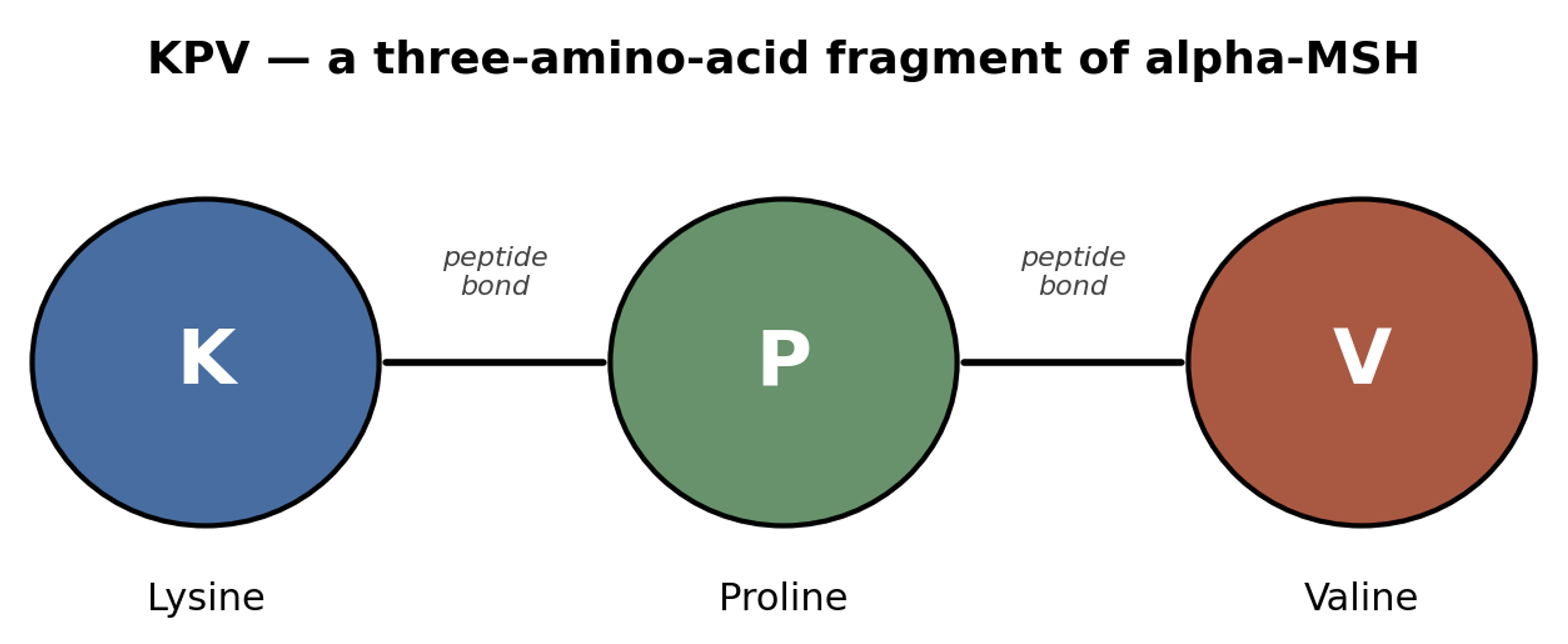
KPV is a tripeptide — a chain of just three amino acids: lysine (K), proline (P), and valine (V). It’s derived from a much larger molecule called alpha-MSH, and this is where people often get confused. KPV doesn’t behave like its parent compound. It doesn’t bind the same receptors, and it won’t drive the skin-darkening effects associated with alpha-MSH or peptides like melanotan II. What it does retain is a strong slice of alpha-MSH’s anti-inflammatory power, specifically in gut tissue.
How It Actually Works Inside the Cell
Most peptides work from the outside in; they dock onto a receptor on the cell surface and trigger a cascade from there. KPV takes a different route entirely: it gets escorted directly into the cell by a transporter called PEPT1, which the gut uses to absorb small peptide fragments.
Once inside, KPV goes to work quieting down two of the body’s major inflammatory signalling systems — NF-kB and the ERK/p38 pathway. NF-kB in particular is a heavyweight driver of inflammation; when it’s switched on, it activates genes that pump out cytokines like TNF-alpha, IL-6, and IL-1β. Dial down NF-kB, and you dial down a huge amount of downstream inflammatory noise.
The Part I Find Genuinely Elegant
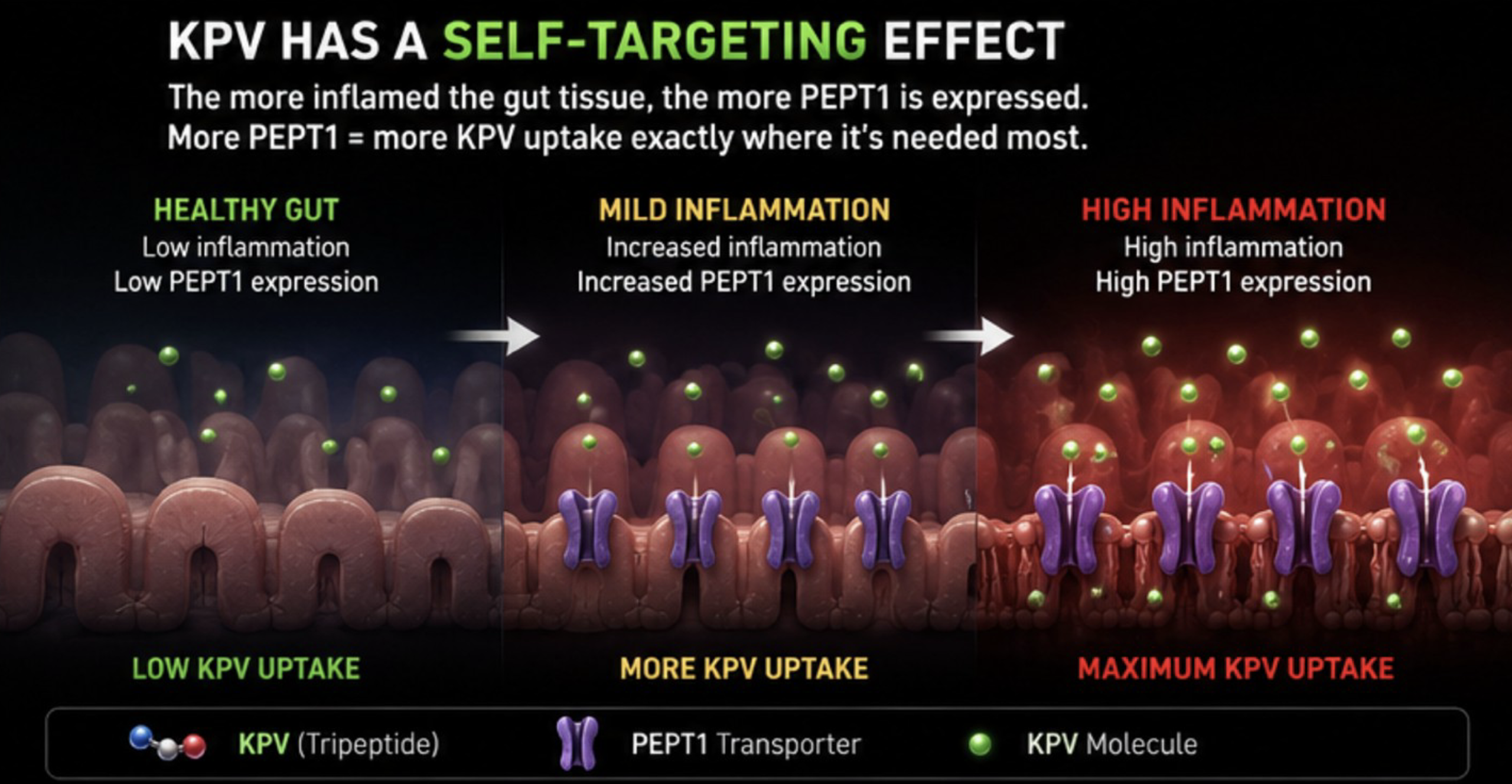
Here’s the detail that got me most interested: KPV appears to target inflamed tissue preferentially, almost like it knows where to go and has the geo mapping and location set out for it to travel.
The logic runs like this: the more inflamed a section of gut becomes, the more PEPT1 transporters that tissue expresses. And since PEPT1 is exactly what ushers KPV into cells, more inflammation effectively means more KPV gets pulled into that specific patch of tissue. The peptide concentrates its anti-inflammatory effect precisely where the body is screaming loudest for it, rather than blanketing the whole gut indiscriminately.
It’s a self-targeting mechanism — the biological equivalent of a system that sends more resources to wherever the fire is burning hottest, rather than spraying water evenly across a building that’s mostly fine.
Follow your Gut.
I’m not going to pretend the science is fully settled and there are countless double-blinded studies, etc. There is ongoing research into how KPV performs in real clinical use, how it might be stacked with other gut-repair peptides, and what dosing protocols make sense.
That’s exactly the kind of work we take seriously at Alchemi before anything reaches a practitioner’s hands: the compounding, the sourcing, the compliance, all of it must hold true and firm. This one is exciting, albeit cautiously due to it being so early.
KPV is, all the same, one of the more promising developments I’ve come across in gut health in a long time.
More to come as we look deeper into dosing, stacking protocols, and what the clinical data actually shows.
Follow the science, and as always, follow your gut.